
How to Choose the Right Flour Mill for Your Family Size and Daily Atta Needs
Choosing a flour mill for your home is not just about picking a machine that looks good or has a powerful motor. The right flour mill for home should match your family's size, daily atta requirements, kitchen space and the type of grains you regularly use.
For some families, a compact home atta chakki may be enough for everyday wheat grinding. Larger families, on the other hand, may need a machine with higher grinding capacity and a larger hopper.
So, how do you know which domestic flour mill is right for your family?
The simple answer is: choose your flour mill according to how much atta you need, how often you grind it and what you expect from the machine.
Let's understand the important factors step by step.
Why Family Size Matters When Choosing a Flour Mill
Every family has different flour requirements.
A family of two or three people may not need the same grinding capacity as a family of six or eight. If you choose a machine that is much larger than your actual requirement, you may not get the practical benefits you expect. Similarly, a small machine may become inconvenient if your family needs a large quantity of flour regularly.
Before buying a home flour mill, start with one simple question:
How much atta does your family normally use?
Your answer will help you understand the type of flour mill that fits your everyday needs.
1. Start With Your Family Size
The first factor to consider is the number of people in your household.
A smaller family generally has lower daily flour requirements, while a larger family may need to grind more wheat regularly.
For example, consider:
- 2–3 members
- 4–5 members
- 6–8 members
- Larger joint families
These numbers don't automatically decide which flour mill you should buy, because eating habits and flour consumption can vary from family to family.
Instead, use family size as a starting point and then consider your actual atta consumption.
A Simple Tip
Don't buy a domestic atta chakki only because someone else uses the same model.
Your family's requirements may be completely different.
2. Understand Your Daily Atta Requirement
Family size is important, but daily atta consumption is even more useful when selecting a flour mill.
Think about how much wheat your family normally uses in a day or week.
Ask yourself:
- How many rotis are prepared every day?
- Does your family eat atta-based meals regularly?
- Do you also make paratha, puri or thepla?
- Do you grind flour once a week or more frequently?
- Do you prefer grinding larger quantities at one time?
These answers can help you understand your actual requirement.
A family that uses only a small quantity of atta may be perfectly comfortable with a compact flour mill for home, while a larger household may prefer higher capacity.
3. Check the Flour Mill's Grinding Capacity
Once you understand your family's flour requirement, look at the grinding capacity of the machine.
Flour mill capacity is commonly expressed in terms such as kg/hr, which indicates the approximate quantity the machine can process in an hour under specified conditions.
However, don't choose a flour mill based only on the highest number.
The important question is:
Does the machine's capacity match your family's actual requirement?
If your family needs only a small amount of fresh flour regularly, extremely high capacity may not be necessary.
If you have a larger family or grind flour in larger quantities, a suitable higher-capacity machine may make the process more convenient.
4. Don't Choose a Flour Mill by Motor Power Alone
Motor power is one of the specifications people commonly check while buying an automatic flour mill.
You may see specifications such as 1 HP, 1.5 HP or other motor ratings.
But motor power alone does not tell you everything about the machine.
The overall performance can also depend on:
- Grinding mechanism
- Grinding chamber design
- Grain compatibility
- Machine construction
- Operating conditions
- Recommended capacity
Therefore, instead of asking only 'How many HP is the motor?', also ask:
'What can this flour mill actually handle for my family's requirements?'
This gives you a more practical way to compare different models.
5. Consider the Types of Flour You Use
Wheat may be the main grain in your kitchen, but many families also use other grains.
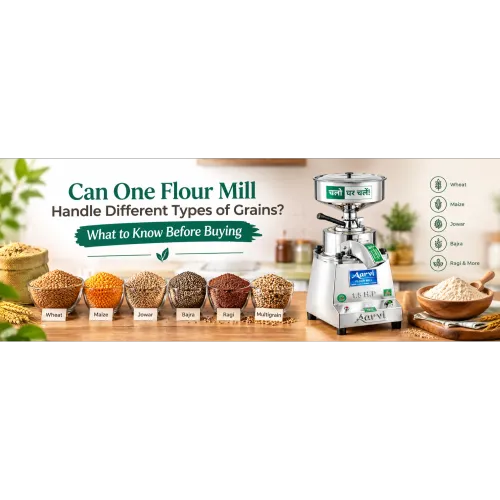
Depending on the manufacturer's specifications, some multi-grain flour mills may support suitable grains such as:
- Wheat
- Jowar
- Bajra
- Maize
- Ragi
- Other compatible grains
However, every flour mill is not necessarily designed for every grain.
If your family regularly uses different grains, check the manufacturer's recommended grain list before purchasing a home atta chakki.
Remember:
More grain options can mean more flexibility, but compatibility should always be confirmed first.
6. Think About How Often You Grind Atta
Your grinding routine also matters.
Some families prefer to grind small quantities frequently, while others prefer to grind enough flour for several days.
Think about your preferred routine:
Daily Grinding
If you like fresh flour every day, a suitable domestic flour mill can become part of your everyday kitchen routine.
Weekly Grinding
If you prefer grinding a larger quantity once or twice a week, you may want to pay more attention to capacity and hopper size.
Occasional Grinding
If you use the machine only occasionally, your requirements may be different from someone who uses it every day.
There is no single perfect grinding routine for every household.
The right flour mill for home is the one that fits your routine.
7. Check the Hopper Capacity
The hopper is another practical feature to consider when choosing a home flour mill.
A suitable hopper allows you to add the required quantity of grain conveniently before grinding.
If your family normally grinds larger quantities, hopper capacity can become more important.
But again, bigger is not automatically better.
Choose a hopper size that matches:
- Your family's flour requirement
- Your grinding frequency
- Available kitchen space
- Your preferred operating routine
The goal is convenience, not simply choosing the biggest specification.
8. Consider Your Kitchen Space
A flour mill is a kitchen appliance, so its size and placement matter.
Before buying a domestic flour mill, decide where you are going to keep it.
Check:
- Available floor space
- Height clearance
- Storage area
- Ease of access
- Distance from other kitchen appliances
- Ease of cleaning around the machine
A machine may have excellent specifications, but if it is difficult to place or access in your kitchen, everyday use can become inconvenient.
Measure Your Space Before Buying
A simple measurement of the available area can help you avoid surprises after delivery.
9. Look at Ease of Cleaning and Maintenance
Fresh flour preparation should be convenient, and cleaning is part of that routine.
When choosing a home flour mill, consider how easy it is to:
- Clean the grinding area
- Remove leftover flour
- Maintain the machine
- Access important parts
- Follow routine cleaning instructions
This becomes especially useful if you regularly grind different grains.
Different grains can leave different amounts of residue, so following the manufacturer's cleaning and maintenance instructions is important.
10. Check the Grinding Mechanism
The grinding mechanism is one of the most important parts of a flour mill.
Instead of choosing a machine based only on its exterior design, understand what type of grinding system it uses and what grains it is designed to handle.
A good buying decision should consider the complete machine:
Motor + Grinding System + Capacity + Grain Compatibility + Ease of Use
Looking at all these factors together gives you a better understanding of whether a particular domestic atta chakki suits your needs.
11. Think About Your Family's Cooking Habits
Two families with the same number of members can have completely different atta requirements.
For example, one family may eat roti only once a day, while another may prepare:
- Roti
- Chapati
- Paratha
- Thepla
- Puri
- Bhakri
- Other atta-based recipes
Some families may also prepare multigrain flour.
That's why family size alone should not decide your flour mill.
Your cooking habits matter too.
12. What Size Flour Mill Is Right for Your Family?
Instead of following a fixed rule, use this simple approach.
Small Family
If you have a smaller household and use limited quantities of atta, focus on:
- Practical capacity
- Compact size
- Easy operation
- Easy cleaning
- Regular household requirements
Medium Family
For a medium-sized family, consider:
- Daily atta consumption
- Grinding frequency
- Suitable kg/hr capacity
- Hopper size
- Grain compatibility
Large or Joint Family
For larger households, pay closer attention to:
- Higher required grinding capacity
- Hopper capacity
- Motor and grinding system
- Regular operating convenience
- Manufacturer-supported grain types
The best choice depends on your actual usage rather than simply selecting a machine according to family size.
13. Should You Buy a High-Capacity Flour Mill?
A high-capacity machine can sound attractive, but the highest capacity isn't necessarily the right choice for every household.
Before choosing a high-capacity flour mill for home, ask:
Will my family actually use that capacity?
If your daily flour requirement is modest, your priorities may be different.
If you regularly grind larger quantities, higher capacity may be more relevant.
So, don't ask:
'Which machine has the highest capacity?'
Instead ask:
'Which capacity makes sense for my family's daily atta requirement?'
That's a much better way to choose.
14. Don't Forget Noise and Everyday Convenience
A flour mill is something you may use regularly, so everyday convenience matters.
When comparing different home atta chakki models, consider the overall user experience, including:
- Operating convenience
- Cleaning
- Maintenance
- Space requirements
- Grinding routine
- Manufacturer support
- Recommended operating method
Specifications are important, but so is how comfortably the machine fits into your daily kitchen routine.
15. Check the Manufacturer's Specifications
Before buying any domestic flour mill, always check the official specifications of the particular model.
Look for information about:
- Motor rating
- Grinding capacity
- Hopper capacity
- Supported grains
- Grinding mechanism
- Machine dimensions
- Operating instructions
- Cleaning requirements
- Warranty and service information
This is particularly important if you want to grind multiple types of grains.
Never assume that two machines with similar-looking designs will have exactly the same capabilities.
A Simple Flour Mill Buying Checklist
Before making your decision, use this quick checklist:
☑ Family size
☑ Daily atta requirement
☑ Grinding frequency
☑ Required capacity
☑ Grain compatibility
☑ Motor and grinding system
☑ Hopper capacity
☑ Kitchen space
☑ Cleaning requirements
☑ Maintenance and service
☑ Manufacturer specifications
If you understand these points, comparing different flour mill for home options becomes much easier.
How to Choose a Flour Mill Based on Daily Atta Needs
Here's a simple way to think about your requirement:
Step 1: Count the number of people in your family.
Step 2: Estimate how much atta your family uses regularly.
Step 3: Decide how often you want to grind wheat.
Step 4: Check the flour mill's recommended grinding capacity.
Step 5: Check whether it supports the grains your family uses.
Step 6: Consider hopper size and kitchen space.
Step 7: Compare the motor, grinding mechanism and other specifications.
Step 8: Check cleaning, maintenance, warranty and service information.
This approach helps you select a home flour mill based on your actual needs instead of choosing only by appearance or motor power.
One Flour Mill, Made for Your Family's Routine
A flour mill is more than just another kitchen appliance. When chosen correctly, it can become a convenient part of your regular flour preparation routine.
Whether you are a small family making fresh atta every day or a larger household that needs to grind bigger quantities, the right domestic flour mill should match your actual requirements.
The important thing is not to ask:
'Which flour mill is the biggest or most powerful?'
Instead, ask:
'Which flour mill fits my family's size, daily atta needs and cooking routine?'
That question can make your buying decision much simpler.
Final Thoughts
Choosing the right flour mill for home starts with understanding your family.
Consider your family size, daily atta consumption, grinding frequency, grain requirements, capacity, hopper size, kitchen space and maintenance needs before making a decision.
For families that regularly prepare fresh flour at home, a suitable home atta chakki can make everyday flour preparation more convenient.
And remember, the right flour mill isn't necessarily the one with the biggest motor or highest capacity.
The right flour mill is the one that matches the way your family actually uses it.
So before you buy, understand your family's atta needs, check the machine specifications and choose accordingly.
Right family size. Right capacity. Right flour mill. Right for your everyday kitchen.
Keywords